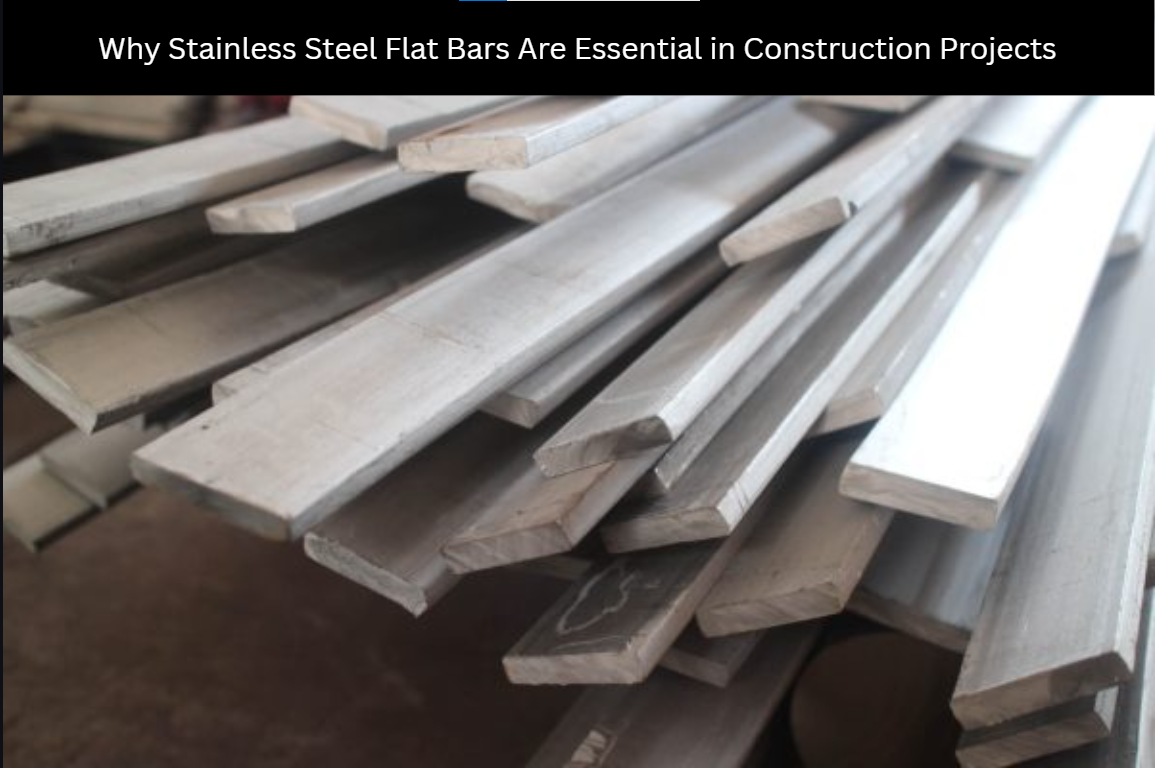
Replacing corroded structural components mid-project can cost three to five times the original material savings. That one fact explains why engineers keep specifying construction grade stainless steel flat bars on projects where structural failure is not an option. Stainless Steel Flat Bars resist coastal salt air, industrial chemical vapour, and the moisture that silently damages mild steel inside wall cavities, holding up for decades without triggering unplanned maintenance budgets.
What Are Stainless Steel Flat Bars?
These are solid rectangular-section products rolled in widths from 10 mm to 300 mm and thicknesses from 3 mm to 50 mm. Hot-rolled bars suit on-site bending; cold-drawn bars hold tolerances of +/-0.1 mm and arrive with a cleaner finish. Three grades dominate construction: SS 304 for general structural work, SS 316 for coastal and chemical environments, and SS 202 for cost-sensitive interior applications.
Key Properties of SS Flat Bars
Excellent Corrosion Resistance
The passive chromium oxide layer self-repairs when scratched, keeping SS flat bars pit-free indoors, outdoors, and in chloride concentrations up to 1,000 ppm for SS 316.
High Strength and Durability
SS 304 posts 205 MPa yield and 515 MPa tensile strength, stable from -200 degrees C to 870 degrees C, with service life regularly exceeding 25 years in standard construction conditions.
Superior Weldability
TIG, MIG, and stick processes work on SS 304 and SS 316 without pre-heat or post-weld heat treatment, and standard shop equipment handles cutting, drilling, and bending without retooling.
Low Maintenance Requirements
No repainting, no anti-rust retreatment: a periodic wash is all that is needed, eliminating the recurring costs that make coated carbon steel expensive over a 20-year lifecycle.
Attractive Surface Finish
Cold-drawn bars leave the mill in a 2B or No. 4 finish, ready for exposed architectural applications without any additional surface preparation.
Why Stainless Steel Flat Bars Are Essential in Construction Projects
Enhanced Structural Support
Flat bars serve as reinforcement strips, connecting plates, and load-bearing ties, with a uniform cross-section that distributes stress evenly and prevents cracking at fixing points.
Long-Term Durability
SS flat bars hold their full cross-section through coastal salt air and industrial vapour, where painted steel loses effective section thickness within 5 to 10 years once the coating cracks.
Cost Savings Over Time
The 20 to 40 percent material premium over carbon steel is recovered within 7 to 10 years once repainting, retreatment, and early member replacement leave the maintenance budget.
Versatile Design Applications
One grade and section can carry hidden structural load in a bracket and deliver a polished finish on an exposed railing in the same building, cutting procurement complexity.
Improved Safety and Reliability
At 40 percent elongation, SS 304 flat bars deform visibly before fracture, giving engineers a measurable warning under seismic or impact overload rather than sudden structural failure.
Applications of Structural Stainless Steel Flat Bars in Construction
Building Frameworks
Structural Stainless Steel Flat Bars are used in tie plates, column stiffeners, and beam connections, including inside wall cavities where moisture collects and inspection is impractical.
Bridges and Infrastructure Projects
Bearing pads, expansion joint covers, and parapet fixing strips on bridges need SS flat bars to eliminate the 8 to 12-year replacement cycles that carbon steel requires in those positions.
Architectural Applications
Facades, safety railings, curtain wall framing, and feature staircases across Indian commercial projects use cold-drawn SS flat bars for a finish that requires no further treatment and ages without discolouration.
Industrial Buildings
SS 316 flat bars take the acid splash, caustic wash, and daily pressure jets inside chemical plants and food-processing warehouses that corrode painted mild steel through in under a year.
Commercial and Residential Construction
Staircase stringers, mezzanine brackets, and high-rise structural assemblies use SS 202 for cost-sensitive interior work and SS 304 wherever load-bearing or moisture exposure is part of the design.
Advantages of Industrial Stainless Steel Flat Bars
Industrial Stainless Steel Flat Bars keep the passive oxide layer intact even where abrasion strips paint daily. Yield strengths above 200 MPa across all three main grades let engineers size sections on actual loads, not inflated degradation factors. Standard shop tools handle fabrication without retooling, and stainless scrap commands real secondary market value in India at the end of life.
Common Grades of Stainless Steel Flat Bars Used in Construction
SS 304 Flat Bars
Accounting for roughly 70 percent of Indian construction use, SS 304’s 18 percent chromium and 8 percent nickel composition covers atmospheric exposure, freshwater contact, and most indoor industrial environments.
SS 316 Flat Bars
Two to three percent molybdenum raises chloride tolerance to around 1,000 ppm, making SS 316 the correct specification for coastal sites, pharmaceutical clean rooms, and marine infrastructure.
SS 202 Flat Bars
Manganese replacing nickel cuts SS 202’s raw material cost 15 to 20 percent below SS 304, making it practical for interior structural assemblies where outdoor or chemical exposure is not a factor.
Factors to Consider When Selecting Stainless Steel Flat Bars
Project Environment
SS 304 covers standard outdoor exposure; SS 316 is needed within 5 km of the sea or any chemical contact application; SS 202 suits dry interior structural work.
Load Requirements
Size from calculated loads: 50 mm to 150 mm wide and 6 mm to 12 mm thick. Handles most reinforcement tasks, but cantilever spans need a proper section modulus calculation.
Grade Selection
Over-specifying SS 316 indoors wastes budget; under-specifying SS 202 in a humid or chemical environment generates repair costs that exceed the savings within three to five years.
Fabrication Needs
Hot-rolled bars suit tight bends; cold-drawn bars suit precision fitting; confirm mill test certificates to ASTM A276 or IS 6911 before accepting delivery.
Budget and Lifecycle Costs
A 20-year model covering fabrication, maintenance, and replacement almost always shows SS flat bars at a lower total cost than coated carbon steel in corrosive or high-traffic environments.
Conclusion
Stainless Steel Flat Bars keep earning their place because the performance numbers across real projects are hard to dispute. SS Flat Bars handle residential balustrades, Industrial Stainless Steel Flat Bars hold chemical plant frameworks together, and Structural Stainless Steel Flat Bars anchor bridge components that do not need to be replaced ahead of schedule. Corrosion resistance, load capacity, and finish quality arrive together, not as a trade-off. Manufacturers like Inox Pumps, part of INOX SUBMERSIBLES (I) PVT. LTD brings over two decades of engineering experience to ensure every project gets the right grade, section, and specification from the start.